Available Properties
 Find an Agent
 Bespoke property sourcing
 Investment App
 Sourced Financial Services
 Get a quote
 Blogs
 Podcast
 Guides
 Webinars
 Investment Strategies
 Choose Your Franchise
 Property Franchise
 Living Franchise
How much do property sourcers earn and charge in the UK?
How do property deal sourcers make money? Typical UK sourcing fees, when they're paid, what a sourcer can realistically earn, and the costs and rules to plan for.

Property sourcers make money by charging investors a sourcing fee for each deal they find and package. In the UK, fees of £4,000 to £10,000 per deal are typical, depending on the deal type and the work involved, and the fee is usually paid when the investor exchanges or completes. A sourcer who completes one deal a month at £4,000 would earn £48,000 a year in fees, before costs.
Earnings vary widely, from a few deals a year to a full-time income. This guide explains how sourcing fees work, what affects how much you charge, what you can realistically earn, and the costs and rules to plan for.
Key takeaways
- Sourcers earn a sourcing fee from the investor, not the seller.
- Fees of £4,000 to £10,000 per deal are typical, with more for complex deals.
- Income depends on how many deals you complete, not how many you find.
- Budget for compliance, insurance and marketing costs.
- Sourcing isn’t quick or easy money. It takes consistent work to build.
How do property deal sourcers make money?
A property deal sourcer finds investment properties, such as below market value, HMO or refurbishment deals, checks the numbers and packages them for investors. When an investor goes ahead, the investor pays the sourcer an agreed fee. The fee covers the time spent finding the deal, negotiating, analysing it and handing it over ready to buy.
Some sourcers also earn from:
- Rent to rent deals, sourcing ready-to-go rent to rent opportunities for operators
- Joint ventures, taking a share of the profit instead of, or as well as, a fee
- Doing deals themselves, such as flips, HMOs or BRRR, as they grow
How much do property sourcers charge?
| Deal type | What affects the fee |
|---|---|
| Below market value buy to let | The size of the discount and the yield |
| Refurbishment and flips | The profit available after works |
| HMOs | The extra work on licensing, layout and room rents |
| Rent to rent | The monthly profit and the contract terms |
| Development and conversions | The scale of the project and the planning work |
Across these, fees of £4,000 to £10,000 per deal are typical. Some sourcers charge a fixed fee. Others charge a percentage of the purchase price, often around 2% to 3%, with a minimum fee. Simpler deals sit at the lower end, while complex HMO, conversion or development deals can command more.
When does a sourcer get paid?
The fee is usually agreed in a written sourcing agreement before the investor sees the full deal details. Payment is commonly made when the investor exchanges contracts or completes. Some sourcers take part of the fee earlier as a reservation, refundable or not depending on the agreement, so the terms must be clear in writing.
How much can a property sourcer earn?
Your income depends on how many deals you complete and the fee for each. As an illustration:
| Deals completed | At £4,000 per deal | At £6,000 per deal |
|---|---|---|
| 1 a quarter | £16,000 a year | £24,000 a year |
| 1 a month | £48,000 a year | £72,000 a year |
| 2 a month | £96,000 a year | £144,000 a year |
These figures are before costs and tax, and they’re examples, not predictions. New sourcers often take several months to complete their first deal, while they build investor relationships and learn to find deals that stand up to scrutiny.
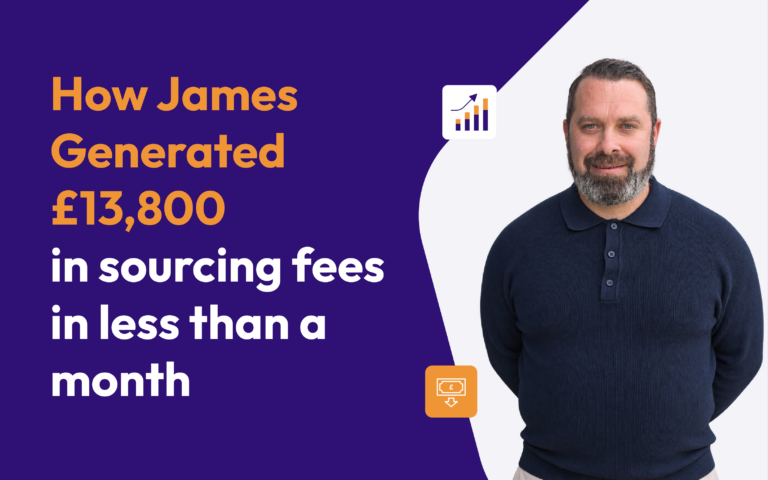
For a real example, read how James generated £13,800 in sourcing fees in less than a month.
What affects how much a sourcer earns?
- Deal quality. Investors pay for deals where the numbers are accurate and the returns are real.
- Your investor list. More trusted investors means more deals completing.
- Your area. Some areas have more discounted or high-yield stock.
- Your strategies. HMO, rent to rent and development deals usually command higher fees.
- Reputation. Investors come back to sourcers whose deals deliver what they promised.
Costs to plan for
- Anti-money laundering supervision with HMRC
- Property redress scheme membership
- Professional indemnity insurance
- ICO registration
- Marketing to find sellers, such as letters and leaflets
- Tools and data for analysing deals
- Training and any franchise fees
Do you need to be registered to charge a sourcing fee?
Yes. Anyone charging a sourcing fee must be registered with HMRC for anti-money laundering supervision and belong to a property redress scheme, such as The Property Ombudsman or the Property Redress Scheme. You should also have professional indemnity insurance and register with the ICO. Investors should check all of these before paying a fee. Read how to become a property deal sourcer.
Frequently asked questions
How much do property sourcers charge?
Fees of £4,000 to £10,000 per deal are typical in the UK, depending on the deal type and work involved. Some charge a percentage of the purchase price, often around 2% to 3%, with a minimum fee.
How do property deal sourcers make money?
They charge investors a sourcing fee for each deal they find, analyse and package. Some also earn through joint ventures, rent to rent deals or doing deals themselves.
Who pays the sourcing fee?
The investor who buys the deal pays the sourcing fee, under a written sourcing agreement.
Is property sourcing profitable?
It can be, once you have a steady flow of good deals and a list of trusted investors. Your profit depends on how many deals complete, your fees and your costs. It usually takes time to build.
How much can a beginner property sourcer earn?
It varies widely. Many beginners take several months to complete a first deal. At £4,000 per deal, one deal a quarter would bring in £16,000 a year before costs, and one a month £48,000.
Build a property sourcing business with Sourced
With the Sourced Property Franchise, you learn to find, analyse and package deals for investors, with Deal Analyst support to check the numbers, an investor network and a Personal Business Manager behind you.